
Cursor 3 in practice: plugins, AGENTS.md, and replacing low-skill testing with criteria
This is a technical note about how we run Cursor 3 on Magento and related work: plugins, AGENTS.md, deploy discipline, flows, and testing. It opens with labour-market context on purpose. We are not selling Cursor or AI tools. We are describing one IDE assistant stack and the pros and cons of introducing it into agency and merchant delivery — including how “more output” can worsen conditions for people who write software for a living.
Do not blame developers for using these tools. In a labour market already hit by AI, adaptation is often a requirement, not a fashion. That is the first point. It is not the last.
History is not a productivity bandwagon. Before reading Garrison Lovely’s Obsolete, I had already been researching labour and automation and landed on Daron Acemoglu and Simon Johnson’s paper Learning from Ricardo and Thompson: Machinery and Labor in the Early Industrial Revolution, and in the Age of AI (MIT, 2024). Strikingly, Obsolete points to the same Acemoglu line of insight. Ricardo once believed machinery would not lessen demand for labour; after watching textile automation — and especially the fate of handloom weavers — he revised that view in the chapter “On Machinery.” Average productivity can rise while workers lose. Real wages for cotton weavers collapsed for years even as the industry grew. E.P. Thompson’s emphasis, which Acemoglu and Johnson take seriously, adds what Ricardo underplayed: factories, surveillance, loss of autonomy, and the political conditions that decide whether workers share gains. Automation does not automatically improve wages or job quality without new tasks, complementary hiring, and bargaining power. See also Reading Obsolete and Words are important.
So: adapting is key. That does not mean conditions get better. What follows in this post — local plugins, versioned AGENTS.md, cheaper model routing, Ansible, e2e, criteria instead of low-skill re-testing — is an early adaptation move and a possible way to survive for some time in IT development. It is not a success story about improved backend-dev labour. I do not know if this path is “good.” I am preparing to change field if needed.
Many people still under-read the IT labour market in early 2026. Consequences are already visible: freezes in employment, freezes in wages, freezes in outsourcing and in tasks for freelancers. We are only scraping the surface. If shops merely adopt Cursor-style tools and push delivery by 5× or 10× over a year without institutional share-back, labour conditions worsen. That is not futurism. It is present pressure prospected about a year out.
With that caution audible, here is the technical how — and a companion deep dive to How I write code with Cursor.
From Cursor 1/2 rules to Cursor 3 plugins
On Cursor 1 and 2 we leaned hard on workspace rules: short must / must-not guardrails living in every repo. That pattern still matters. Cursor 3 introduced plugins as a product feature — it does not ship Magento or Hyvä behaviour for us. The Magento and Hyvä assistants are what we write ourselves (rules, skills, subagents) and attach via marketplace or, for privacy-constrained projects, a local / private team path. We picked that up because the payoffs looked larger than the cons: one shared plugin for the team and the IDE, enable/disable per workspace, instead of dozens of per-repo .cursor folders repeating the same rules. That is maintainability for roughly 90% of the rules. Project-specific must / must-not still belong in versioned AGENTS.md.
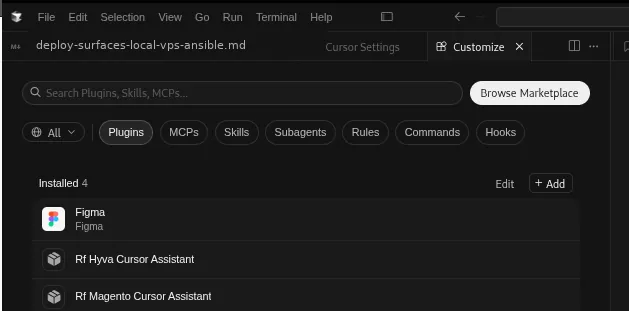
Our Magento and Hyvä assistants live as source under a private team plugins tree on the workstation. Colleagues who want to experiment can clone and attach the same way. The point of local install is control: what code the IDE loads, for which folders, without forcing every project through a public marketplace.
AGENTS.md as mutual enforcement
Plugins are not enough. Project-specific non-negotiables belong in a versioned AGENTS.md at the Magento root — a team file every agent that honours the convention should read first. On this stack it carries Rule #0 (curl / “Endpoint verification” is not a product test), hard Magento cache invariants, Ansible as the deploy shape, and pointers to app/code/AgentDocs/flows/ — short scenario packs (IDs and steps) for storefront and Admin checks; more on those in the section below. That is how must / must-not stay mutual between humans and models when Cursor 3’s plugin surface alone is too generic.
Stack facts that must not leak into git — ports, SSH wrappers, operator IPs, container names — stay in gitignored DEVELOPMENT-LOCAL.md. Same split as always: process and invariants versioned; local coordinates private.
Cost: Opus burn, then Auto plus guardrails
In June 2026, intensive Cursor 3 use with Opus-class models for long Magento and testing sessions ran well over $2,000/month on our side (my development work as a single developer, not a team invoice). Switching to Cursor Auto, switching between two monthly plans based on projected usage, and spending roughly two months reassessing AGENTS.md, plugins, Bugbot, and stop conditions brought spend into roughly $60–$200/month with comparable delivery quality. Cheaper or less “frontier” models needed patience: clearer boundaries, not louder prompts.
That saving is operational, not a labour victory. Lower token bills do not raise wages. They can even make it easier for firms to demand more volume. Keep the intro caution in mind when anyone treats “we got the same results cheaper” as proof the market improved.
Bugbot (opt-in, checks-only; local review via dedicated subagent / skill; Autofix off; never a done gate by itself) adds continuous cheap pressure on diffs before push. It does not replace human judgment or suite tests.
Ansible, e2e, and documented flows
Deploy is not “git pull and hope.” We use Ansible for VPS Magento deploy shapes and we exercise the same discipline locally so the pattern is tested, not improvised — see our ops audit on local vs VPS vs Ansible surfaces. Improvisation is how environments diverge and how agents invent unsafe one-offs.
End-to-end coverage lives in our project e2e suite (Playwright under the team e2e app). Cursor helps author and maintain that suite with the same rules/skills philosophy. The IDE’s integrated browser is excellent for interactive storefront and Admin checks; it does not fully replace the suite. Both need documented flows — scenario IDs under app/code/AgentDocs/flows/ (for example storefront smoke, blog layout, Admin local smoke). Without criteria on disk, “the agent tested it” is theatre.
AgentDocs, audits, incidents
Versioned AgentDocs, dated audits, and INCIDENT-* reports are how the assistant keeps institutional memory across chat resets. A stack-trace folklore in Slack dies; a short incident file with headers, TTL notes, and “do not” lines survives. That is craft hygiene, not bureaucracy for its own sake.
Focus: replace low-skill re-testing with criteria
My focus now is heavily on testing — not because testing is glamorous, but because much operator re-testing (agency and merchant) is low-skill work that does not grow the person doing it. That layer can be largely replaced by matching documented criteria: flow IDs, Bugbot, Magento PHPUnit unit tests, integration where the harness is in scope, the e2e suite, and automated checks in MCT. That is not “no verification.” It is refusing to spend scarce human attention on click-paths a machine can match once the criteria exist. People who previously spent their days testing — and who already know the frontend user stories well — can put that knowledge where it compounds: defining and documenting user stories, writing criteria, and improving them over time, instead of manually repeating “x orders,” “x add to cart,” and the same checkout paths again.
Curl returning 200 remains coding hygiene, not a storefront or Admin test. That rule stays non-negotiable in AGENTS.md.
Takeaway
Cursor 3 plugins, AGENTS.md, cheaper Auto routing, Ansible, flows, AgentDocs, and criteria-based verification are how we currently work. They are adaptation under labour-market pressure — not a sales pitch, not proof that backend conditions improved, and not a prediction that 5×–10× delivery will save the profession. For the shorter discipline overview, start with How I write code with Cursor.
Written with the help of an AI assistant.