
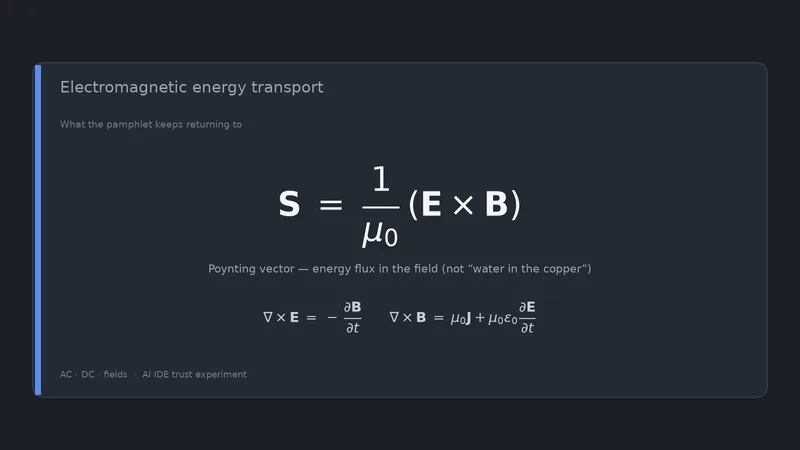
Testing an AI model's context trust in the IDE: a hands-on electromagnetic-fields pamphlet stress test
How much can I trust an AI assistant via IDE work on well-known logic and technical detail? And when the conversation window resets — as it does, often — can the model stay on the same problem, or does it quietly reinvent the problem?
Reading about “context windows” only goes so far. A stress test is clearer. So I chose a project shape that would expose the boundary: write a short technical book in a field where I am not the expert, on purpose, and watch what holds.
Why a book, and why physics
A pamphlet forces structure. You cannot hide behind a one-file patch. You need chapters, definitions that do not contradict each other, diagrams that match the prose, and a rebuild path that still works next week. That is a better probe of “does this stay coherent?” than asking the model to restate Ohm’s law once.
I picked physics and electricity — AC vs DC, fields, Maxwell in plain language, everyday EMI — because school teaches a clean story and practice often disagrees with the folklore. I had doubts. Challenging something taught early is a good way to see whether an assistant will double down on slogans or help you rebuild a careful picture.
The work had many faces on purpose: English (the pamphlet language), electronics, electricity, physics, and enough chemistry to talk about copper, lattices, and charge without waving hands. A broad surface is how you force an assistant to lose the thread — if it is going to lose it.
A hostile workspace on purpose
I did not open a clean “physics” project. I wrote inside a subdirectory of an IT / OpenPLC brewery workspace that was not about EM theory at all. The IDE plugins loaded into the chat were Magento- and PLC-shaped, not physics tutors. That was deliberate: if context is only whatever the last tool dump shoved into the prompt, the pamphlet should have drifted into brewery alarms and Controllino pinouts.
What pointed at the real goal was local and boring: a README in the pamphlet subdirectory that named the English electromagnetic-fields book, plus an explicit brief — what I wanted, what I doubted, and why I was challenging school-shaped explanations. The living artefact was a gated .md source in that folder, not a vibes chat.
What actually happened
Context was not lost in the way I expected. The chat still reset. Sessions still forgot. But the job did not, because organisation was strict and the work was gated: source markdown, figures with rebuild scripts, a PDF build, licensing, authoring conventions. When the model came back cold, the subdirectory was still the contract. That is the same discipline I use on Magento and PLC work — rules, bounded runbooks, named “done” — applied to a domain I was deliberately less fluent in.
The experiment did not prove that AI “knows physics.” It proved something more useful for craft: trust attaches to process and artefacts, not to the eloquence of the last reply. Where I could check against known references and against the rebuilt PDF, I could accept help. Where I could not evaluate the claim, speed would have been a liability — same rule as shipping code I cannot read.
Related notes on this blog: How I write code with Cursor, Reading Obsolete, and AI IDE privacy. The brewery side of the same workspace shows up in Reverse-engineering OpenPLC — different goal, same bias toward readable artefacts.
Read the pamphlet here
The artefact from that experiment is AC, DC, and the Electromagnetic Field — A Practical Quick Reference (April 2026). Below is the PDF in-page (browser viewer); same file as download if you prefer offline.
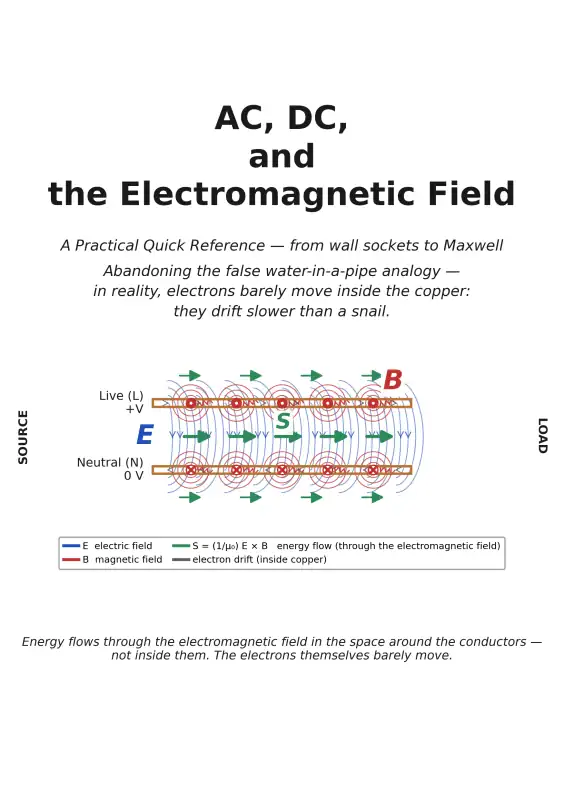
Takeaway
I set out to make the assistant lose the plot. Broad domain, wrong workspace plugins, periodic context resets. What kept the work coherent was not magic memory: it was a subdirectory that told the truth about the job, and gates that refused a half-finished book. That is also how I decide what to trust in an AI IDE for software — not the confidence of the sentence, but whether the artefact still makes sense when the chat is gone.
Written with the help of an AI assistant.